For decades, the Indian legal landscape has been dominated by a “legacy” system. While second and third-generation lawyers often inherit established chambers, vast libraries, and high-profile clients, first-generation lawyers are frequently left to navigate a complex, often exclusionary environment.
Advocate Rudra Vikram Singh, President of the First Generation Lawyers Association (FGLA), is now spearheading a movement to dismantle these barriers. Through strategic Public Interest Litigations (PILs) and community building, Singh is challenging the status quo of favouritism and elitism that marginalizes talented newcomers.
Challenging the Status Quo: The Fight Against Discriminatory Appointments
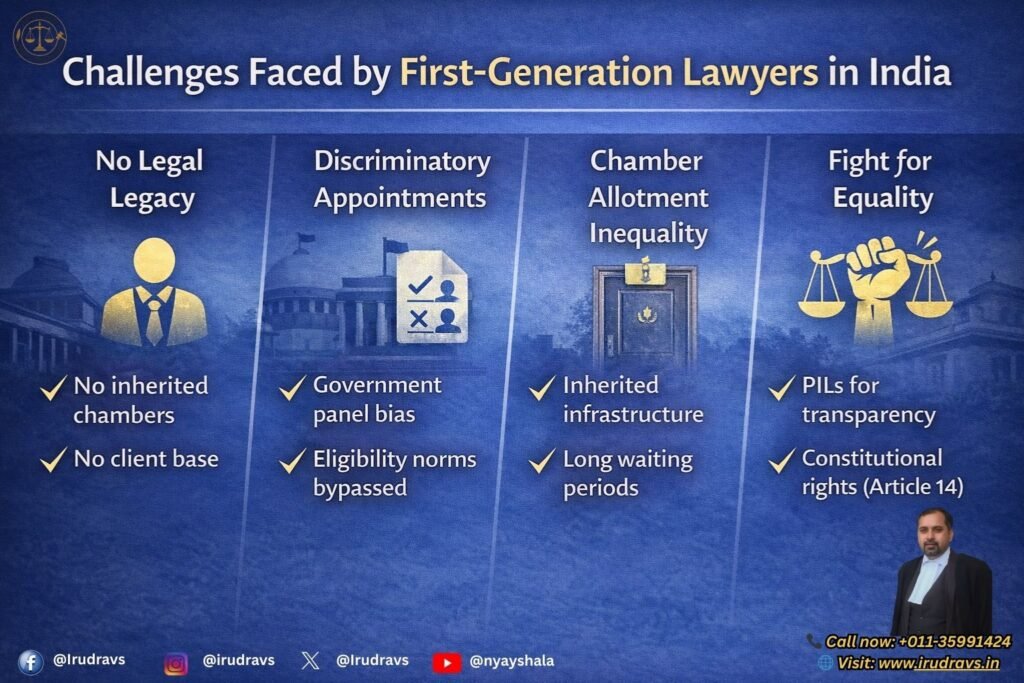
The FGLA recently gained national attention by filing a PIL in the Delhi High Court challenging the appointment of 650 government counsel. Advocate Rudra Vikram Singh points out a glaring discrepancy: over 100 of these appointees reportedly do not meet the mandatory criteria set by the Bar Council of India (BCI).
“The Centre has included advocates who enrolled as recently as 2024 and 2025 to represent the government before the Supreme Court,” says Advocate Rudra Vikram Singh. “This bypasses the rule requiring years of practice in district and high courts, effectively prioritizing those with political or judicial ‘connections’ over qualified first-generation practitioners.”
The “Inheritance” of Infrastructure: Chamber Allotment Issues
Infrastructure is another battlefield. The FGLA has challenged the 1980 rules for chamber allotments in the Delhi High Court. Currently, Rule 5-A allows for the “inheritance” of chambers by spouses or children of existing allottees.
For a first-generation lawyer, securing a workspace is a monumental hurdle. Advocate Rudra Vikram Singh argues that this “arbitrary and discriminatory system” violates Article 14 of the Constitution, which guarantees equality before the law. By treating chambers as family property, the system denies young, self-made lawyers the foundational resources needed to succeed.
A Digital and Pro Bono Future
Advocate Rudra Vikram Singh is not just fighting in the courts; he is building a modern, tech-savvy community. The FGLA utilizes AI and digital conferencing to bridge the gap for lawyers who cannot afford traditional office setups. However, Singh remains a proponent of “cautionary AI,” advising that while technology is excellent for case law research, it should not replace the rigorous drafting skills of a human lawyer.
The association’s commitment to pro bono work—from seeking justice for civil servant aspirants in Rajinder Nagar to fighting the “coaching mafia”—demonstrates that first-generation lawyers are often the most connected to the struggles of the common citizen.
“Leveling the Legal Playing Field”
The movement led by Advocate Rudra Vikram Singh is more than just a series of lawsuits; it is a call for a merit-based legal system. As the FGLA prepares for the national conference in January 2026, the message is clear: legacy should not be a prerequisite for justice.
Are you a first-generation lawyer looking for mentorship and representation? [Join the First Generation Lawyers Association today] to be part of the change.
Read more click this link : First generation lawyers body president interview: Rudra Vikram Singh Speaks Out on Nepotism and Discrimination in Indian Legal System